
Jeep Oil Change Guide: Intervals, Oil Types & Warning Signs
Think you’re not driving enough to damage your engine?
Well, that’s what might be damaging your
engine!
Sounds a bit backward, doesn't it?
Short trips don’t give your powertrain
enough time to reach its optimal operating temperature. When an engine doesn’t
fully warm up, moisture and unburned fuel condense in the crankcase, meaning
your oil doesn’t circulate or clean the system the way it was designed to.
Add in North Jersey’s freezing winters,
blistering summer humidity, and the grueling stop-and-go gridlock on Route 17,
and your engine oil starts breaking down significantly faster than it would on
a long, smooth highway cruise down the Parkway.
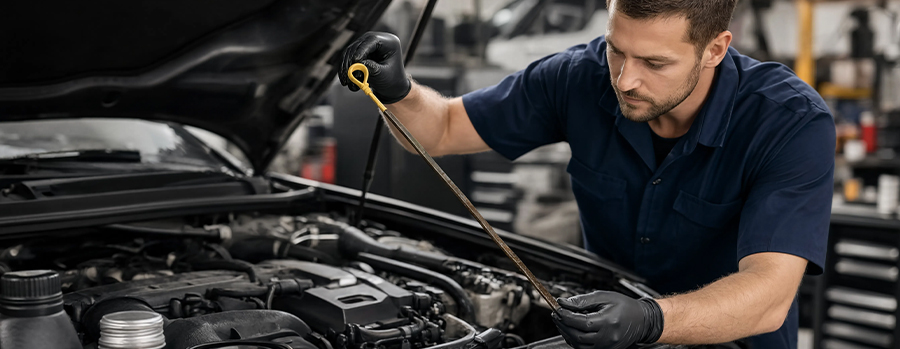
In this comprehensive guide, we’ll break
down everything you actually need to know about
getting a Jeep oil change. From decoding the exact type of oil your specific
model requires to understanding how often you
should schedule a Jeep Oil Change service based on local driving habits, we
have you covered.
We'll also look at critical warning signs
you shouldn't ignore, how to perform a Jeep oil change reset, and how to find
the best certified maintenance without the second-guessing.
Why an Oil Change Matters More in Bergen
County
Driving around Paramus isn’t as easy on
your vehicle as it might seem on paper. Between the dense traffic surrounding
our major shopping corridors, the seasonal temperature swings of the Northeast,
and the construction dust frequently kicked up around our local highways, your motor oil undergoes severe thermal
stress.
Regularly scheduling a Jeep oil change
service isn't just routine maintenance; it is an active insurance policy for
your engine. Fresh, high-quality oil serves several vital functions:
- Minimize Friction: Lubricates moving metal components to prevent catastrophic
internal wear.
- Manages Heat: Carries thermal energy away from the combustion chamber to
keep the engine running cool.
- Cleans Internal
Components: Suspends harmful dirt, debris, and
carbon particles, carrying them to the filter.
- Prevents Sludge Build-up: Blocks the chemical transformation of old oil into a thick,
engine-choking gel.
- Optimizes Efficiency: Reduces mechanical drag, helping you get the maximum possible
miles per gallon.
Skip these crucial intervals, and your
engine immediately starts working harder, running hotter, and paving the way
for costly repairs down the line.
What Type of Oil Does Your Jeep Use?
The ideal oil for your vehicle depends
entirely on the engine configuration and model year, but nearly all modern Jeep
models are factory-engineered to run on advanced, full synthetic oil
formulations that meet strict manufacturer standards (such as MS-6395).
Here is a general breakdown of the most
common oil weights used across the lineup:
|
Engine /
Model Type
|
Recommended
Oil Viscosity
|
Oil Type
|
|
Modern 3.6L
Pentastar V6 (Grand Cherokee, Wrangler)
|
0W-20 or 5W-20
|
Full Synthetic
|
|
2.0L Turbo
Inline-4 (Wrangler, Cherokee)
|
5W-30
|
Full Synthetic
|
|
1.3L
MultiAir Turbo (Renegade, Compass)
|
0W-30
|
Full Synthetic
|
|
High-Performance
Engines (SRT / 392 V8 Models)
|
0W-40
|
Full Synthetic
|
Note:
Engineering specifications change frequently. Always confirm the exact oil
grade, viscosity, and fluid capacity listed in your specific Jeep owner’s
manual before performing any service. Using API-certified oil that satisfies
factory material standards ensures proper variable valve timing (VVT)
performance and long-term component reliability.
Full Synthetic vs. Conventional Oil: The Real
Difference
Not all engine oils are created equal,
and this choice makes a profound difference in how your vehicle handles the
daily North Jersey commute.
- Full Synthetic Oil: Synthesized in advanced laboratories, this oil features
highly uniform molecular structures. It provides superior resistance to extreme
heat, flows smoothly in sub-zero winter temperatures, resists thermal breakdown
longer, and keeps internal components free of sludge.
- Conventional Oil: Refined directly from crude oil; conventional lubricants
feature irregular molecular sizes. They break down much quicker under severe
heat, flow sluggishly in extreme cold, and require much shorter change
intervals to prevent performance degradation.
Because modern engines feature tighter
tolerances and advanced turbocharging systems, full synthetic oil is the
standard required to maintain your factory's powertrain warranty.
How
Often Should You Schedule a Jeep Oil Change?
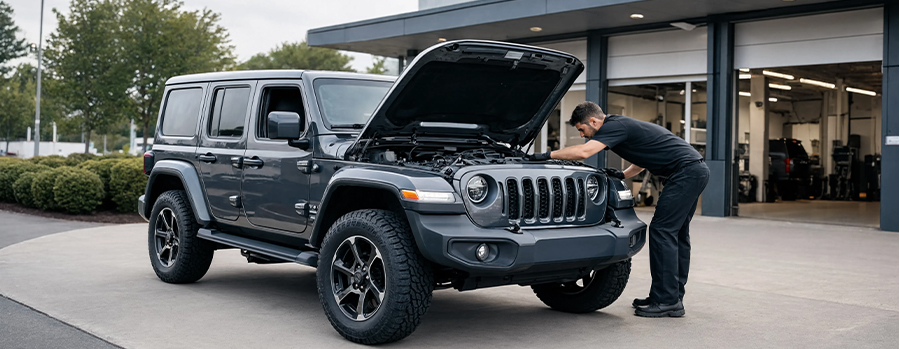
If you read generic advice online, you
will see a massive variation in suggested intervals. The realistic guidelines
break down like this:
- Every 5,000 to 7,500
Miles: Ideal for vehicles driven primarily on
long, smooth highway trips under moderate weather conditions.
- Every 3,000 to 5,000
Miles: Necessary for vehicles subjected to
"severe driving conditions", which includes frequent short trips
under 10 miles, prolonged idling, stop-and-go city traffic, towing, or driving
in extreme hot or cold climates.
- Up to 10,000 Miles: Maximum allowable limit for newer models equipped with
advanced oil-life monitoring systems operating under perfect conditions.
How to
Perform a Jeep Oil Change Reset
Modern Jeeps are equipped with an
automated Oil Life Monitor system that calculates oil degradation based on
engine temperatures, driving habits, and operating hours. Once your oil is
freshly changed, the dashboard indicator must be manually updated.
If you need to perform a Jeep oil change
reset at home, follow this straightforward step-by-step process:
-
Without placing your foot
on the brake pedal, press the engine START/STOP button twice to place
the ignition in the "ON/RUN" position (do not actually start
the engine).
-
Using the directional
arrows on the left side of your steering wheel, navigate through the driver
information cluster menu until you locate the "Vehicle Info"screen.
-
Scroll up or down to find
the "Oil Life" sub-menu.
-
Press and hold the "OK"button on the steering wheel for several seconds until the oil life percentage
resets back to 100%.
Alternative Method: Turn the ignition to the "ON/RUN" position,
slowly depress the accelerator pedal completely to the floor 3 times within
10 seconds, then turn the ignition "OFF." While resetting
the system is simple, doing so without actually changing the fluid is
incredibly dangerous. It is the automotive equivalent of muting a smoke alarm
instead of putting out the fire.
What
Happens If You Skip Your Oil Service?
Neglecting your engine maintenance
triggers a rapid chain reaction of mechanical degradation:
-
Thermal Overheating: As oil breaks down and loses viscosity, friction increases
exponentially, raising engine temperatures to dangerous levels.
-
Sludge Accumulation: Old oil oxidizes into a thick, tar-like sludge that restricts
fluid passages, starving critical components like camshafts and bearings of
oil.
-
Accelerated Engine Wear: Microscopic metallic debris circulates freely through the
block, scoring cylinder walls and damaging piston rings.
-
Total Component Failure: Over time, oil starvation causes moving parts to weld
themselves together, completely seizing the engine and resulting in thousands
of dollars in avoidable repair bills.
Imagine getting stuck on the shoulder of
Route 4 during rush hour because your engine overheated. It’s a stressful,
expensive situation that is entirely preventable.
Final
thoughts: Get Your Service Done Right!
Engine maintenance isn't a chore you can
continually push off until "next week." Later has a frustrating way
of turning into a rougher drive, diminished performance, reduced fuel economy,
and unexpected repair bills.
By utilizing premium full synthetic
lubricants, genuine factory parts, and certified technicians who follow exact
factory procedures, you keep your vehicle running precisely the way it was
engineered to perform.
Before you search for a generic shop and
hope for the best, head over to our website to browse our latest Jeep oil
change coupons and promotional specials. Protect your investment, safeguard
your warranty, and enjoy peace of mind on every drive.
Schedule your professional Jeep oil
change service at CDJR of Paramus today before "later" turns into a
problem.
